
Pak-EPA Urges CDA to Enhance Sewage Treatment Plant Operations Amid Capacity Constraints
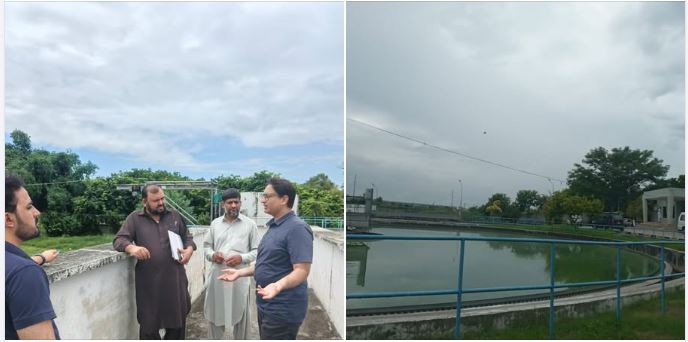
Under the direction of Director General Pak-EPA, Ms. Nazia Zaib Ali, the Pakistan Environmental Protection Agency (Pak-EPA) Environmental Monitoring Team (EMT) conducted an inspection visit to the Capital Development Authority (CDA) Sewage Treatment Plant (STP) in Islamabad on 27th August 2025.
The primary objective of the visit was to assess the current operational status and environmental performance of the treatment plant. The EMT, accompanied by the Senior Chemist, also inspected the on-site Water Testing Laboratory.
During the inspection, it was noted that the laboratory performs tests on only a limited set of five basic water quality parameters, which are insufficient for a comprehensive evaluation of the plant’s performance. Additionally, a majority of the laboratory equipment was found to be non-functional, raising significant concerns about the reliability and scope of ongoing water quality monitoring.
Regarding treatment efficiency, the Secondary Treatment process, specifically the Activated Sludge Process (biological treatment), was observed to be underperforming. In the Primary Treatment stage, where sedimentation (clarifier) tanks are expected to remove around 40% of the Biological Oxygen Demand (BOD), laboratory results revealed that only about 10% BOD removal is currently being achieved, which is considerably below acceptable standards.
The plant’s focal person highlighted ongoing financial constraints and a lack of sufficient budget, which have severely impacted the plant’s operation and maintenance activities. Furthermore, with the rapid population growth in Islamabad, the current capacity of the STP is inadequate to cope with the increasing volume of sewage, especially from the city’s most densely populated areas.
In light of these findings, Pak-EPA stresses the urgent need for CDA to upgrade and expand the STP facility, restore the functionality of laboratory equipment, and enhance monitoring capabilities. It is imperative that treated wastewater meets national environmental quality standards before safe discharge into natural water bodies or reuse in irrigation, landscaping, or industrial applications.